Experience Was the Moat. Now It's the Bottleneck.
Experience still matters in HVAC. The problem is what happens when too much of it is trapped inside too few people.
AI Summary
Explains why senior experience remains valuable in HVAC but becomes a bottleneck when companies cannot distribute it across the rest of the team.
For years, experience was the thing that separated strong HVAC companies from average ones.
It still is, honestly.
You can feel it on a service call. An experienced technician walks in, looks at the symptoms, and cuts through the noise faster. Fewer wasted motions. Fewer bad guesses. More confidence, both for the tech and for the customer standing there trying to decide whether to trust the diagnosis.
That kind of experience became a real moat for a lot of businesses.
It also created a problem.
When your best people become infrastructure
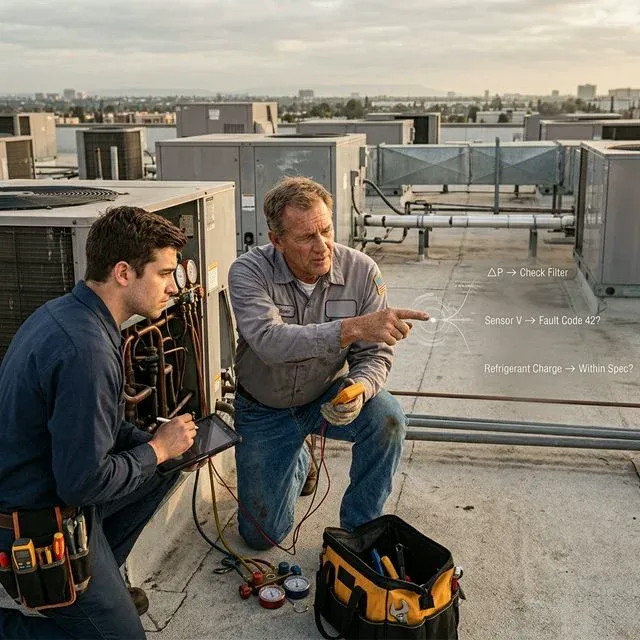
The more a company relies on a small group of veterans, the more those people become the operating system. They are not just your best technicians anymore. They are your escalation path, your quality control layer, your unofficial trainers, and the reason certain callbacks never happen.
Great advantage, right up until the business tries to grow around it.
Then the moat starts acting like a bottleneck.
The BLS outlook for HVAC technicians helps explain why this keeps happening. The field is projected to add jobs, with about 40,100 openings a year on average from 2024 to 2034, and the occupation typically requires long-term on-the-job training. That means real field experience is valuable, slow to build, and easy to overload.
Admiring experience is not the same as distributing it
You see the bottleneck in small ways first. Junior techs pause too long on common calls. Mid-level techs still need reassurance on jobs they should be able to carry. Senior techs spend too much of the day answering questions that never should have reached them.
The company grows, but the dependency grows with it.
Which is why experience has become something businesses need to operationalize instead of simply admire.
On the ACLogics homepage, that idea shows up in practical language: guided workflows that help junior technicians level up, and a built-in second check for senior technicians trying to catch missed details before they become callbacks. That framing is useful because it avoids the usual AI nonsense. The point is not to flatten expertise. The point is to let expertise travel farther than one person’s phone can.
The win is reach, not replacement
This is the part that matters most. Good systems do not make experience irrelevant. They make experience less trapped.
A junior technician can move inside a stronger process. A senior technician can spend more time on edge cases and less time cleaning up ordinary misses. Owners get a team that behaves with more consistency even when experience levels are uneven.
It is a much healthier version of scale than building a company that quietly depends on three exhausted people.
So yes, experience was the moat.
The catch is that it became the bottleneck too.
The shops that win from here will not be the ones that merely have experience. They will be the ones that know how to spread it.
Related reading
- The Hidden Constraint Inside Every HVAC Business
- ACLogics App: The AI Diagnostic Tool Built for Field Technicians